EMBRAER
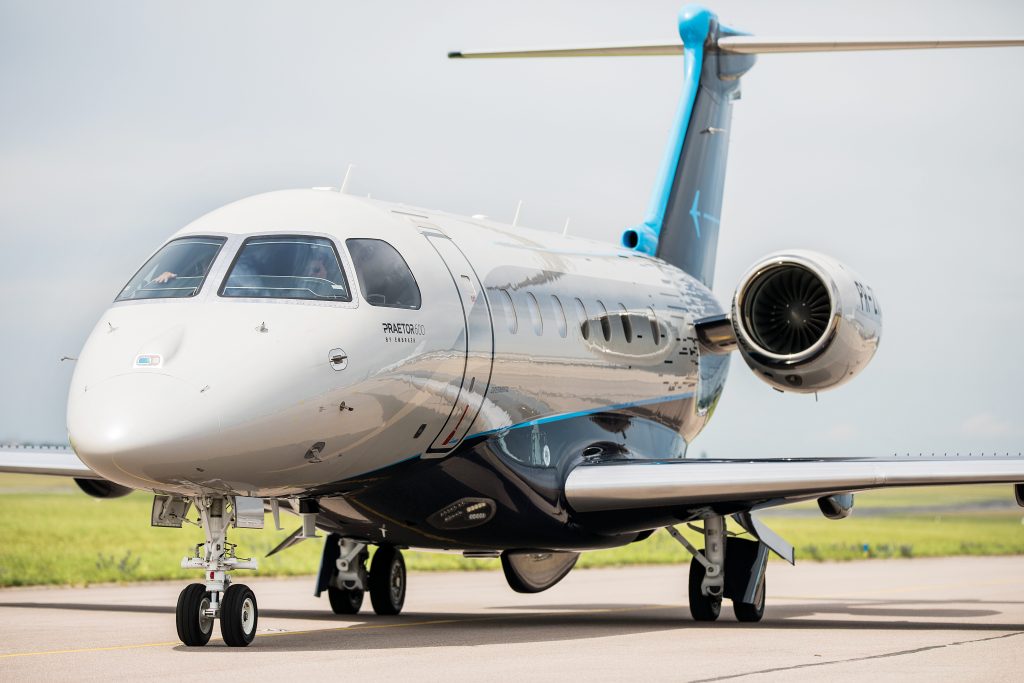
Praetor 600 establishes itself among super-midsize jets
When Embraer presented the Praetor 600 during NBAA-BACE 2018, its intention went beyond updating the Legacy 500: it was to reposition itself in the competitive super-midsize jet segment, then dominated by models such as the Bombardier Challenger 350, Gulfstream G280, and Dassault Falcon 2000, and about to receive the recently launched Cessna Citation Longitude as a new competitor.
Although modern, equipped with fly-by-wire, advanced avionics, and a functional cabin, the Legacy 500 did not offer the same range as its rivals and lacked some elements considered essential by operators in the category. Seven years later, the Praetor 600 has established itself as one of the most balanced offerings in the segment, combining effectively intercontinental range, operational efficiency, and a cabin that makes the most of the available space and comfort.
While the main competitors deliver ranges between 3,200 and 3,600 nautical miles, the Praetor 600 achieves 4,018 nautical miles with four passengers and NBAA reserve. This allows for operations such as São Paulo–Miami or Recife–Madrid, routes that traditionally required larger aircraft.
The acquisition cost is also competitive compared to direct rivals. In cost per hour, the Praetor 600 frequently appears among the most efficient in the segment, rivaling the Citation Longitude and surpassing the typical Challenger 350 mark in a standard operation.
Design and avionics...The Rockwell Collins Pro Line Fusion suite places the Praetor at a higher level within its category. A combined vision head-up display (E2VS), vertically scanned radar, ADS-B In, CPDLC, fully paperless operation, and four interchangeable displays form a typical set of larger aircraft.
But the highlight is the third-generation fly-by-wire system, one of the most sophisticated systems installed in a super-midsize aircraft. It creates stall protection, limits excessive pitching, smooths structural loads, and preserves attitude during turbulence. The autothrottle reduces workload, and the automatic fuel management system eliminates in-flight interventions.
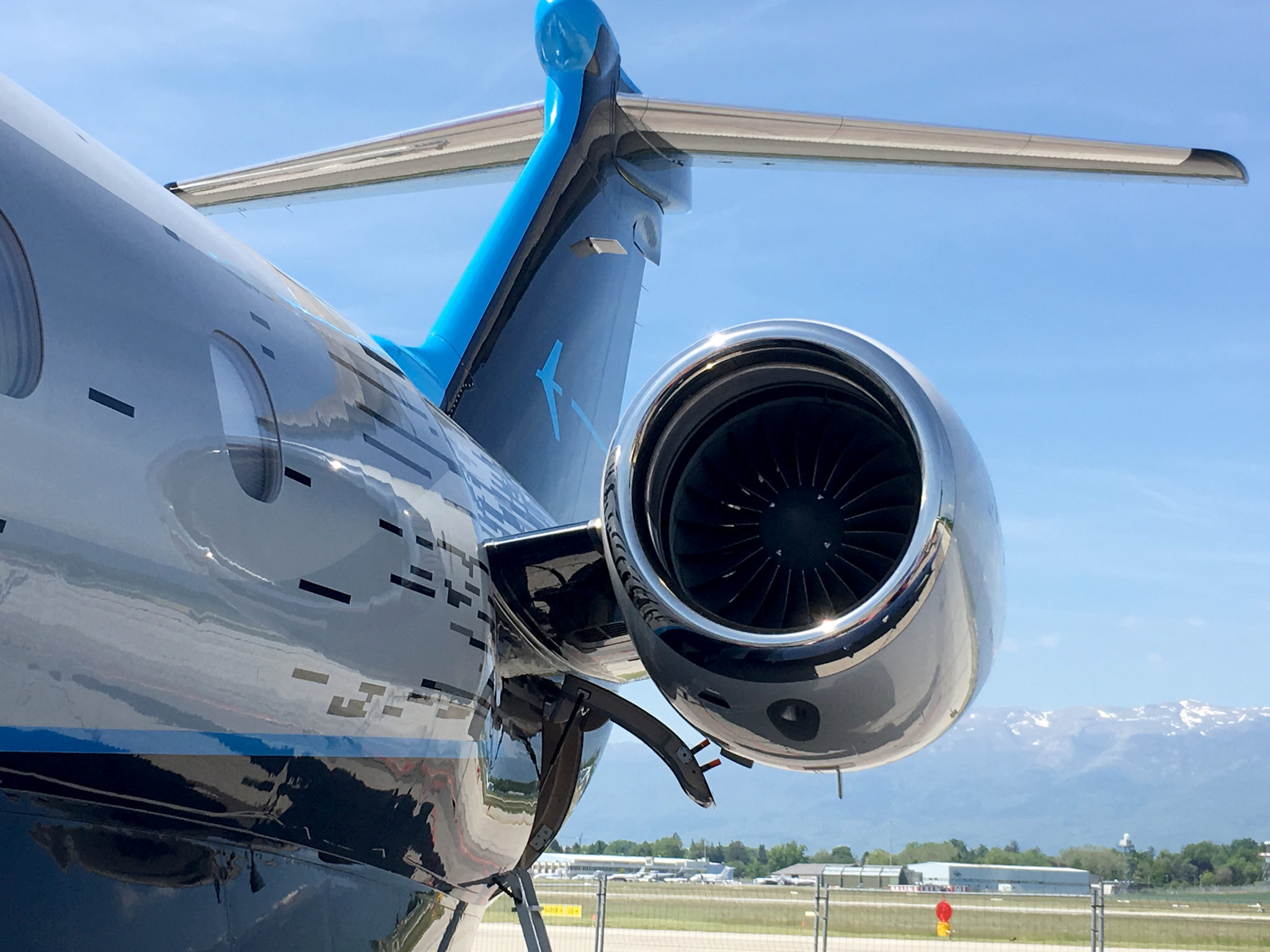
The two Honeywell HTF7500E engines, with 7,528 lb of thrust, allow the Praetor 600 to take off in approximately 1,440 meters, among the best marks in the segment. Aircraft traditionally recognized for their performance on short runways, such as the Challenger 3500, achieve similar results — and yet, without offering superior range.
In climb, the Praetor 600 goes from sea level to FL370 in just over 13 minutes, surpassing most of its direct competitors. In cruise, it maintains Mach 0.80 as its typical speed, reaching an MMO of Mach 0.83. At maximum speed, it ties with the Challenger 3500, but lags slightly behind the G280 and the Falcon 2000, both capable of reaching Mach 0.85. In operations on extremely short runways, some competitors may have a slight advantage, but usually in a different configuration.
The combination of a slatless wing, aerodynamic refinement, and FBW allows it to remain stable, precise in its controls, and with smooth behavior even on steep descents using the speed brake.
The Praetor 600 is derived from the Legacy 500, but the level of evolution is profound: new ventral tanks, redesigned winglets, structural adjustments, complete cockpit modernization, and expansion of the weight and fuel envelope. The goal was clear: to create a super-midsize jet with a real-world range superior to that of traditional competitors, without sacrificing runway performance or the operational familiarity of Legacy operators.
Cabin and comfort... At 1.83 m high, 2.07 m wide, and with a completely flat floor, the Praetor 600's cabin is among the most comfortable in its category. Although some competitors—such as the Falcon 2000 and Challenger 350—offer slightly wider cabins, the Praetor compensates with the longest cabin among traditional super-midsize jets, guaranteeing a greater sense of longitudinal space.

The interior can be configured for eight to twelve passengers, with club seats, divans, and options such as massage functions in the seats. The finish follows the Embraer standard: club seats that convert into beds, the option of massage seats, configurable lighting, and individual digital panels above each seat. The galley is complete—with an electric oven and microwave—and the vacuum toilet, rare in the category, ensures better odor control. Another differentiating factor is the pressurization: 5,800 feet at FL450, a value generally found in larger aircraft and which reduces fatigue on long flights. In practical terms, it rivals some wide-cabin jets.
The external baggage compartment, one of the largest in its class, can carry up to 400 kg and easily accommodates larger volumes than those accepted by the Longitude and G280. Combined, the two compartments place the Praetor among the super-midsize jets with the highest total baggage capacity.
Comparative Perspective...In direct comparison with its main rivals, the Praetor 600 stands out in several aspects, such as having the longest cabin among super-midsize jets. Pressurization is also among the best in the segment, ensuring less fatigue on long flights, while runway performance is among the most efficient for aircraft with its operational radius, requiring shorter takeoff distances than most competitors with similar range. In terms of automation, the fly-by-wire system offers a level of protection and control precision not found in current rivals.

On the other hand, the Praetor 600 loses or ties in some specific areas. The cabin width is smaller than that offered by the Falcon 2000 and the Challenger 350 and 3500, which continue to lead in terms of perceived lateral spaciousness. The Challenger 3500, in particular, stands out for its high level of comfort, combining a wider cabin than the Praetor 600 with Nuage seats, recognized as among the most ergonomic and sophisticated in the category. The Praetor 600 represents more than just an evolution of the Legacy 500; it has redefined expectations in the super-midsize segment. With intercontinental range, a modern cockpit, a quiet cabin, and competitive operating costs, it has established itself as a benchmark for operators seeking versatility and efficiency without sacrificing comfort.
However, in the coming years, it will face competition from the recently launched Gulfstream G300. It is not yet known how the new jet will perform in terms of deliveries, real-world range, costs, and runway performance, but its launch clearly signals that competitors are moving into one of the most strategic segments of business aviation.
by Vivaero


Comments
Post a Comment