GULFSTREAM
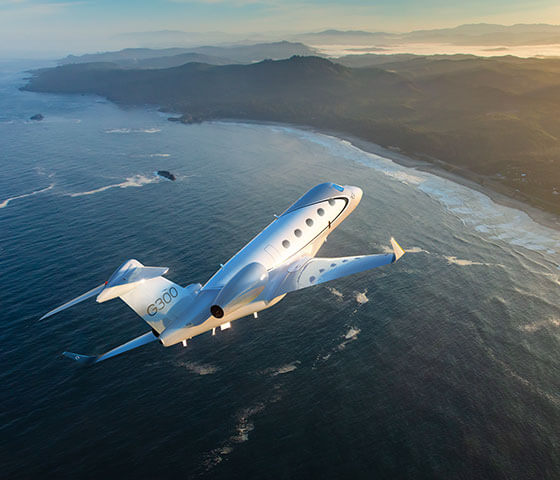
Gulfstream G300 arrives to challenge super midsize segment leaders
On December 5th, the Gulfstream G300 completed its first flight from Ben Gurion Airport in Israel, marking the start of the testing campaign and a decisive advance in development. The prototype remained in flight for 2 hours and 25 minutes, fulfilling the first stage of the certification program.
The model succeeds the G280 in the super midsize segment, consolidating the strategy of offering a standardized line of cabins and avionics, initiated with the launch of the G500 and G600.
It's important to highlight that, although the name refers to an older Gulfstream G300 produced between 2003 and 2004—a version of the GIV-SP, with three cabin zones and a range of 3,485 nautical miles—the new G300 is a completely different project, developed on the G280 platform and incorporating a new elongated fuselage, panoramic windows, and the Harmony Flight Deck avionics suite.
The G300 was announced during the Discover the Difference event, held at Gulfstream headquarters in Savannah, Georgia, on September 30, 2025. The presentation marked the sixth launch of a new Gulfstream model in a decade, demonstrating the continued investment in renewing its line of business jets.
The very emergence of the G500 and G600 occurred less than ten years after the announcement of the G650 in 2008, which inaugurated a new phase for the manufacturer by gradually replacing the traditional GV family and its derivatives, establishing the technological and design standard that guides its entire current generation of aircraft.
Developed in the USA and assembled in Israel...At the time of the launch, Gulfstream President Mark Burns presented a full-scale mock-up and images of the first example being assembled on the Israel Aerospace Industries (IAI) line in Tel Aviv, responsible for the production of the super midsize models.
The cooperation between Israel Aerospace Industries (IAI) and Gulfstream Aerospace consolidated one of the most important chapters in modern executive aviation. In the late 1980s, IAI developed the Galaxy, successor to the Westwind, with the aim of creating a midsize jet capable of offering continental range and reduced operating costs. The model made its first flight in 1997 and marked the transition of Israeli engineering to comfort and performance standards typical of the North American market.
In 2001, Gulfstream acquired the rights to the program, officially incorporating it into its line and renaming it the Gulfstream G200, whose structural production remained in Tel Aviv, with finalization and certification carried out in Savannah, Georgia.
This partnership evolved into the development of the G280, launched in 2012, which introduced a new wing, Honeywell HTF7250G engines, and Collins Pro Line Fusion avionics, maintaining IAI's industrial base and North American integration.
The current G300 preserves this legacy by combining IAI's structural expertise with Gulfstream's technological standardization, reflecting the technical and industrial continuity between generations of super-midsize jets derived from the Galaxy.
“We know the importance of the super midsize segment to our customers and, by developing the G300 based on the successful G280 program, we will bring new energy to the category with advancements in technology, safety, and comfort,” said Burns.
The G300 project retained part of the G280's structural architecture but received a 60-centimeter increase in cabin length, new oval panoramic windows, and integration of avionics derived from Gulfstream's larger models.
The structural changes required revisions to electrical, hydraulic, and pressurization systems, as well as extensive ground testing, which has already totaled approximately 22,000 hours of laboratory testing, including campaigns at the integration center with the iron bird system. Meanwhile, the first prototype has accumulated more than 2,000 hours of ground testing, while two other test aircraft are in production at IAI. Deliveries are expected to begin in the first half of 2028.
The G300 maintains the performance parameters of the G280, with a maximum range of 3,600 nautical miles at a long-range cruise speed of Mach 0.80, or 3,000 nm at a high-speed cruise speed of Mach 0.84. The maximum operational speed (MMO) is Mach 0.85. The service ceiling reaches 45,000 feet, with a cabin altitude limited to 4,800 feet in flight at 41,000 feet—the lowest value in its category. The takeoff distance, under ISA conditions and maximum weight, is 1,457 meters, ensuring good performance on short runways.
The aircraft will be equipped with two Honeywell HTF7250G engines, with a thrust of 7,624 lbf each. The maximum takeoff weight is declared at 18,030 kg, while the maximum landing weight is 14,832 kg. One of the highlights is the basic operating weight of 11,059 kg and the maximum payload reaches 1,733 kg; however, with full tanks, the G300 can carry up to 408 kg of payload. The total fuel stored is 6,632 kg, distributed in the wings and central fuselage.
The combination of 19.20 m wingspan, with a new clean profile and conventional controls with yoke, according to Gulfstream, ensures stable and predictable behavior, preserving the recognized flight characteristics of the previous generation, but with the ability to operate with greater margins at regional airports and restricted runways.

Cabin and comfort...The elongated fuselage allowed the G300 to offer the longest cabin in its category, with a total length of 10.36 meters and 8.41 meters of usable passenger space, excluding the baggage compartment. The internal height is 1.85 m and the width is 2.11 m, providing space for full movement while standing. One of the G300's biggest highlights is the total cabin volume of 28.46 m³, with a baggage compartment of 120 3.40 m³ and accessible in flight. Following the trend of the category, the interior offers two cabin zones, configurable in three distinct arrangements, accommodating up to ten passengers and convertible into five beds. The cabin now features Gulfstream's signature panoramic oval windows, which, in addition to standardizing the brand's style, offer better natural lighting and views of the outside area.
As with other models in the family, the pressurization and air conditioning system ensures 100% fresh air, without recirculation, complemented by plasma ionization for purification and particle removal.
Also noteworthy is the acoustic insulation, which follows the standard of the higher-end series, promising to reduce noise and vibration to levels lower than those found in other super midsize models. In recent years, this has been a point of particular attention for manufacturers, who have considerably increased the acoustic insulation capacity in medium and super midsize aircraft. The rear lavatory uses a vacuum system, and there are options for a fully equipped galley for long-duration missions.
Avionics and Systems... One of the G300's distinguishing features is the new Harmony Flight Deck, based on the Honeywell Epic 2 suite, with six high-resolution touchscreens. The system was developed to standardize the operational experience of the Gulfstream line, offering a common interface between the G500, G600, and G700 models, even though these aircraft utilize more robust avionics within the Gulfstream Symmetry Flight Deck concept.

Even so, the G300 integrates Synthetic Vision technology in the Primary Flight Display (PFD), which presents terrain, obstacles, and runways in three-dimensional images, enhancing pilots' situational awareness, similar to larger models. Another highlight is the integration of the Predictive Landing Performance system, which calculates the stopping point on the runway in real time, adjusting parameters according to wind, weight, and weather conditions.
Additional features include Phase-of-Flight Intelligence, which automatically adapts the screens to the flight phase; and an optional Head-Up Display (HUD) on the captain's side. The autopilot system features control logic derived from ultra-long-range models. The electrical system utilizes redundant architecture and complete digital management, while conventional hydraulics ensure precise control sensitivity without the complexity of fly-by-wire.
The standardization of the basic avionics suite architecture also represents logistical savings and unified training for operators who already own other Gulfstream models. System commonality promotes interoperability within the corporate fleet, reducing support and training costs for pilots and technicians.
Vivaero


Comments
Post a Comment